Exhibition detail
Dock Project: Eat the River by the River
Dates
May 1 - Jun 7
Location
4777 Binjiang Blvd, 4777, Pudong, China, 200010
Pudong
Shanghai
Press Release
From the Yangtze River to the Sea, towards COOP
Artist: FRTS2COOP (Gong Hao, Zijie, Yuan Ziyuan )
Curator: Ren Baiyu
Executive Producer: Derek Yu
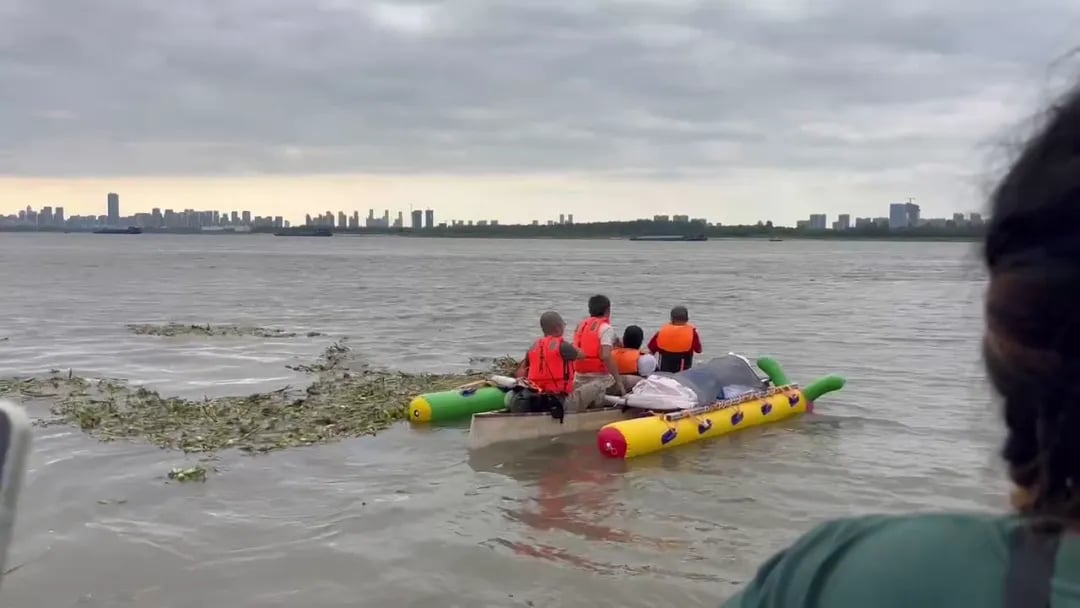
In 2025, Art Group FRTS2COOP ( Gong Hao, Zijie, Yuan Ziyuan ) set off from Wuhan, rowing downstream along the Yangtze River. Their route passed through different cities including Ezhou, Huangshi, Wuxue, Jiujiang, Hukou, Pengze, Anqing, Chizhou, Tongling, Wuhu, Ma'anshan, Nanjing, Zhenjiang, Jiangyin, Zhangjiagang, Taicang, and finally reached Shanghai. They departed on September 20 and came ashore on November 15. The total distance was 1,200 kilometers, with 31 days spent on the water. Boatbuilding, setting out to sea, and voyaging on water are archetypal scenes in countless fables: returning home, tracing origins, embarking on adventures, seeking revenge—if one is to wrestle with something out at sea, the journey must be made by water. Yet FRTS2COOP had no purpose outside the voyage itself. They simply wanted to "drift all the way to Shanghai." Why did they want to drift to Shanghai, no one could tell. Even if there was an answer, it came to them afterward. It would happen after their departure, inside the water, it would happen when they pack up their tents and row back into the river every morning.
When humans and water inhabit each other, the voyage transforms from fable into a bodily act. Trying to stay warm, cooking for themselves, choosing the right place to camp for the night, consulting tide schedules—these are the deeply realist parts, including the most fundamental decision to go downstream as their group name suggested. This decision implies a willingness to cooperate rather than to challenge: to collaborate with the terrain, the wind direction, the current, the weather, the group members, the people encountered along the way, and the unforeseen events of the journey. In fact, the entire voyage is a constant ferrying between adventure and practicality, freedom and constraint. This may seem far from the usual spirit of fable, yet it is precisely what carries the small boat to the sea—to the place of dream and the idealist. As David Graeber emphasizes in Pirate Enlightenment, or the Real Libertalia, stories of voyages on water have endured because they "embody a vision of human freedom, a vision that still feels meaningful today." The exhibition invites viewers to return to the waters that they experienced, to taste the fascinating paradox between buoyancy and gravity: the most romantic aspect of such a voyage is precisely that it is firmly rooted in realism. If anything is more remarkable than a fable of a voyage on water, it may be the one that actually happened.
Apple Tree Submarine
Artist: Oh-Seok Kwon
Curator: Ren Baiyu
Executive Producer: Derek Yu
Born in South Korea in 1969, artist Oh-Seok Kwon moved to Germany after he finished his study as a sculptor, to continue his education at the Art Academy in Munich. Yet after years of sustained practice, he still could only support his life through part-time work at an art museum. Every morning, he once said, each morning, when he locked his studio in order to install works in museums, he was repeatedly overcome by a sense of self-devaluation.
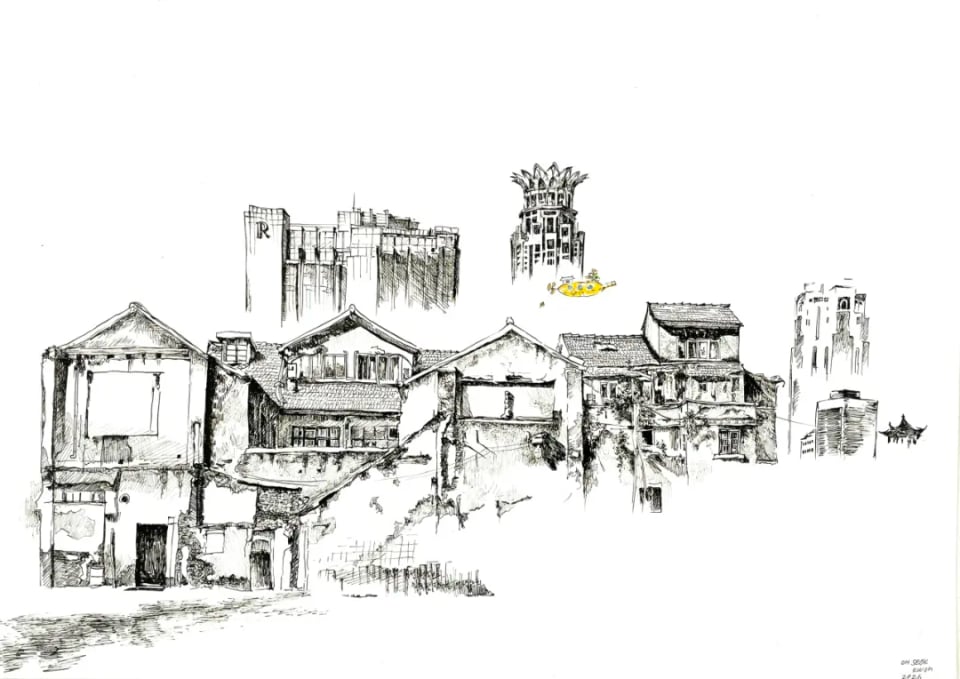
A daily, repetitive, long-lasting predicament had nearly became life itself. After decades of living inside it, one is quietly worn down by despair. Around 2017, he began seriously considering giving up his artistic practice. One day, he wrote in his diary about a submarine that could take him away. On this submarine there would be an apple tree. If the propeller broke, the leaves of the apple tree could serve as its blades. One day on his way to work by bike, he even saw this submarine, shining as if it was made of gold, floating above the trees. He decided that his final art project would be to build a Submarine in pure Gold.
In this fable-like image, the submarine is light. Its only source of power is its belief system and requires nothing else. It lingers among the mountains, by the water, above the city. From its view point, the world reveals itself to the artist as a wholeness that has never been limited. But in the real world, to build it is hard. To find gold is hard. This is the gravity of the earthly world. This contradiction is not unfamiliar. It is, in fact, the very contradiction between vision and reality that the artist had long experienced. Only this time—perhaps because it was the last chance, perhaps because despair can sometimes release immensely strong energy—he found a way. To raise the one kilogram of gold needed for the submarine (it will be made of only gold), he would paint one hundred drawings, on the theme of the submarine. Each painting would be worth ten grams of gold. By the time he had exchanged all one hundred drawings, the submarine would be realized.
This is the methodology the artist has created for the submarine, through a series of achievable, small-unit actions. From zero to one hundred, it takes faith and also time for the submarine above to be completed on the ground. Yet there is no denying that each painting is a genuine one-hundredth of the submarine, and each exchange is another person embracing and joining his imagination.
Images of the exhibition