Exhibition detail
Pei Yanqing: The Wind in the Woods
Dates
Sep 4 - Oct 30
Location
First Trust Co.Building, Beijing East Road No.270, Huangpu District, Shanghai, China
Huangpu
Shanghai
Press Release
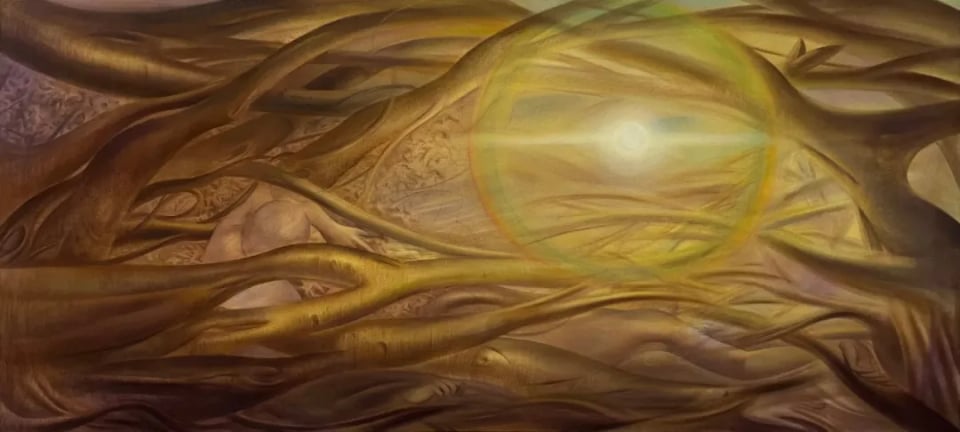
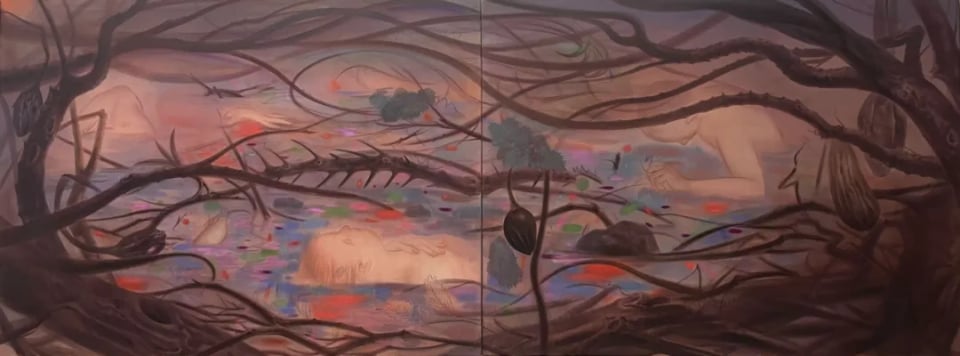
Plants truly constitute the core and origin of Pei Yanqing's intrinsic concern in painting. Forests, groves, shrubs, vines, green leaves, flowers and fruits, roots and stems—plant life at multiple scales is carefully gathered and thoughtfully laid out across the picture plane. This undoubtedly stems from Pei Yanqing's ineffable natural affinity for plants, yet it goes far beyond that. In fact, the irreplaceability of plants lies not only in their biological existence as components of ecosystems, but more fundamentally in the way they directly constitute the very site where life occurs. Thus, attention to plants means not merely focusing on individual organisms, but recognizing the complete system of life. It is precisely here that Pei Yanqing has long imagined and woven, through painting, the trans-species kinships that root her practice.
All things flow in mutual transformation, interdependence, and coexistence. Pei Yanqing regards her creative work as a poetic imagining of these multiple relationships. Coexistence is not simply juxtaposition, nor merely containing plants, animals, and humans within the same space; rather, it is the ceaseless mutual influence of all things in the visible and invisible, the sensible and insensible. The real story is far more tumultuous and complex. From ancient times of animistic belief, to the modern age's ambition to conquer nature, to this very moment of ecological crisis, humans have, whether actively or passively, continually measured and adjusted their relationship with nature. If civilization once positioned humanity outside of nature, then Pei Yanqing's work firmly re-places the human being within the world.
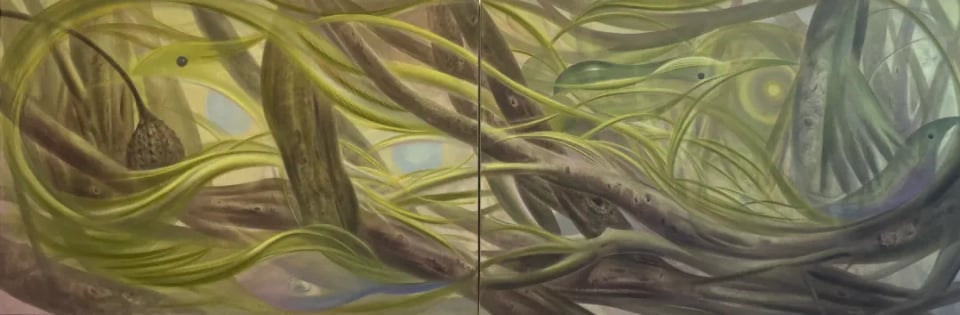
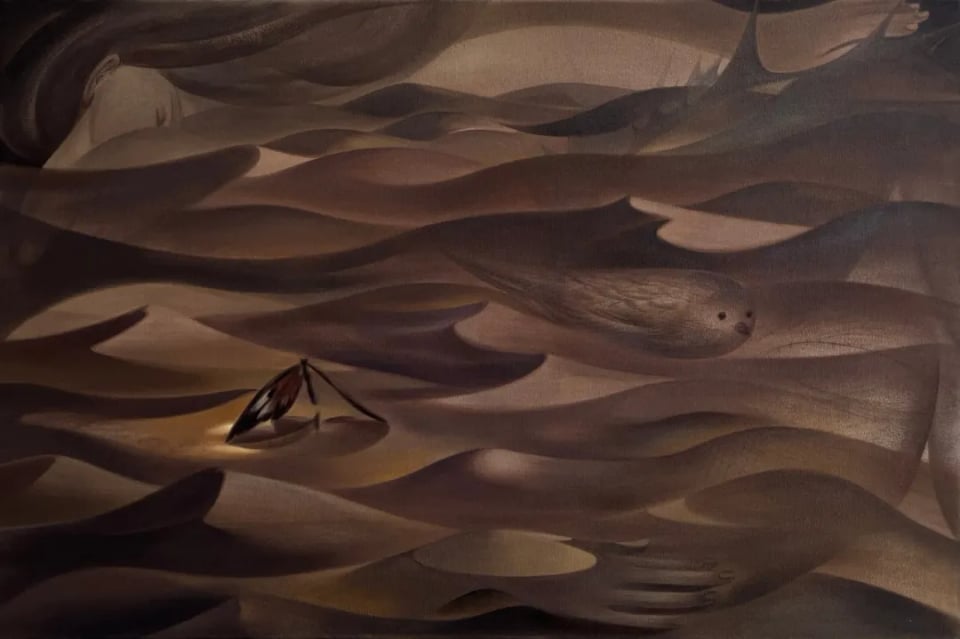
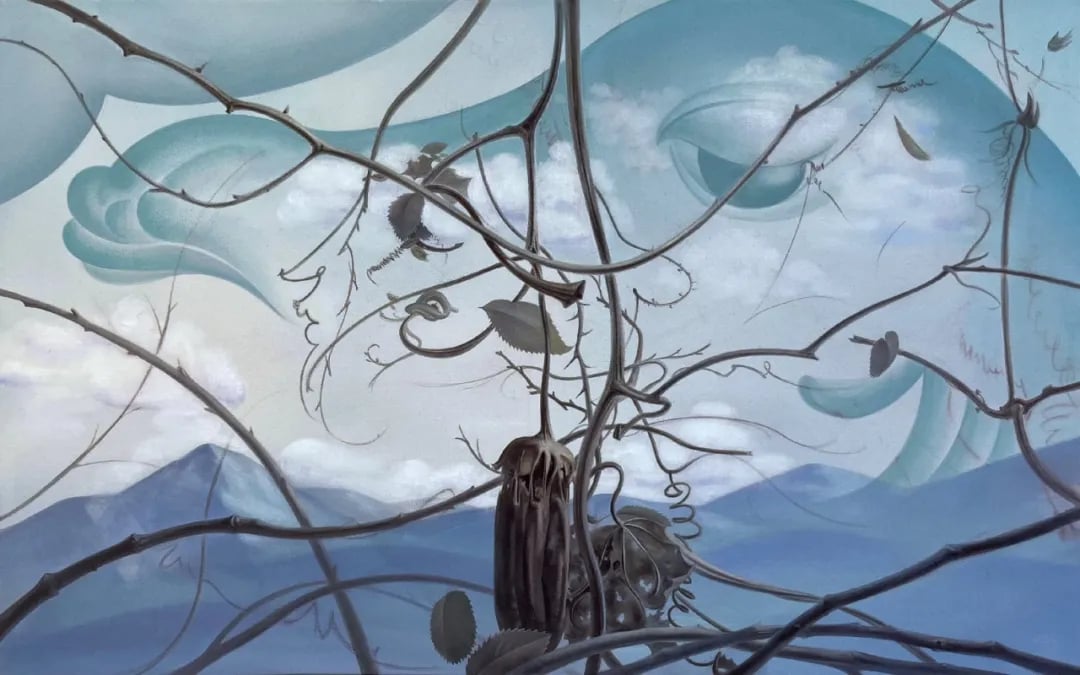
In Pei Yanqing's paintings, she transforms into a transparent body, wandering and threading through a poetic forest interwoven with reality, memory, and imagination, recording her ever-shifting field of vision. Undulating lines, following the movement of the body, intersect and tangle across the picture plane, pushing and chasing one another to extend the deep forest further outward on both sides. The handscroll is a distinctive format in traditional Chinese painting. Compared to the instantaneous creative process and the unobstructed viewing experience, the long horizontal expanse of the handscroll accommodates multiple perspectives and extended time. Pei Yanqing's inheritance of this tradition lies not only in her years of training in Chinese ink painting, but more importantly in her resonance with the possibility of bearing an open world within a finite pictorial space.
The rigid boundaries between things in reality are continuously softened and dissolved in Pei Yanqing's paintings; she returns the world to an infinite amalgam. Along the lines, the volume of objects takes form, while the flow of light and shadow gradually gathers density. Lines do not constitute boundaries between living beings, but rather serve as guides for their mutual transformation. Thus branches, birds, and the breath of the wind merge into an indivisible whole. Wind is the world's breath, as formless as time; its existence can only be confirmed through the changing shapes and colors of things. With image overlapping image, color enveloping color, it is difficult for us to extract any one element independently from Pei Yanqing's paintings. After many years of working with oil paint as her primary medium, the influence of traditional Chinese painting continues to take effect in her practice. Every brushstroke leaves an unalterable trace; every application of color is handled with sufficient lightness. Over time, what accumulates on the canvas is not physical thickness, but a breathing room preserved within translucent, low-saturation color layers. There are also seasons and day-and-night cycles in Pei Yanqing's paintings, yet time is never fixed; it drifts and shifts between light and dark, density and dilution.
Images of the exhibition