Exhibition detail
SHUM Kwan Yi: Sinking in the Floating World
Dates
Apr 24 - Jun 18
Location
Beijing East Road No.211, Huangpu District, Shanghai, China
Huangpu
Shanghai
Press Release
Curator: Chan Yu Ying
Artist: SHUM Kwan Yi
Hive Center for Contemporary Art is pleased to announce Sinking in the Floating World, the first solo exhibition in Shanghai by artist SHUM Kwan Yi, opening on April 24, 2026, at Hive Becoming | Shanghai. As the 62nd iteration of the Hive Becoming Project (HBP), the exhibition brings together over thirty recent paintings by the artist. SHUM Kwan Yi lives and works in Hong Kong, working primarily with ink on paper.The exhibition takes “sinking currents” as its central condition, examining how individuals sustain a mode of existence as external turbulence erodes structural stability. Curated by Chan Yu Ying, the exhibition runs through June 18.
Within the cosmological schema of traditional Chinese landscape painting, mountains and water form a dialectic of yin and yang—hard and soft, solid and void. From the Wei and Jin dynasties through the Tang and Song, landscape was never merely a representation of nature; it was a spiritual pathway for the literati, a means of "roaming the spirit" and "taking nature as mentor." Water, though never dominant, permeates all things through its formlessness, embodying a strength that does not contend—as the Daoists tradition holds: The highest goodness is like water, benefiting all things without contention (上善若⽔、与世无争).
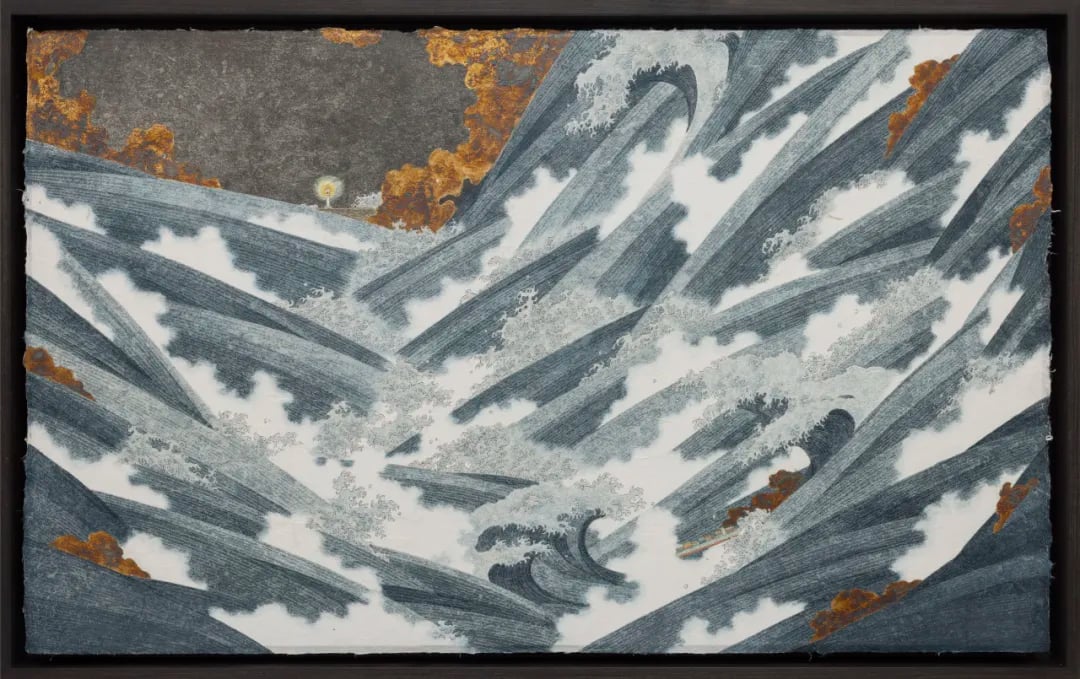
Yet when this understanding of water turns toward the ukiyo-e of Japan, the sea reveals a different face. In The Great Wave off Kanagawa by Katsushika Hokusai, enormous waves press down like claws, and tiny human boats sway upon their crests. Water is no longer a gentle carrier but an invisible force capable of destroying everything—void conquering substance, formlessness shattering form.
Sinking in the Floating World departs precisely from this shift. In contemporary circumstances, turbulence comes not only from visible social conflicts but also from those forces that are difficult to name yet persistently operative: time, information, emotion, and the aftershocks of history. When the forces of reality appear unassailable, the power of the "void"—water, clouds, wind—operates in ways more insidious and destructive. They seep like water, slowly and silently eroding reality, causing once-stable structures to loosen and sink.
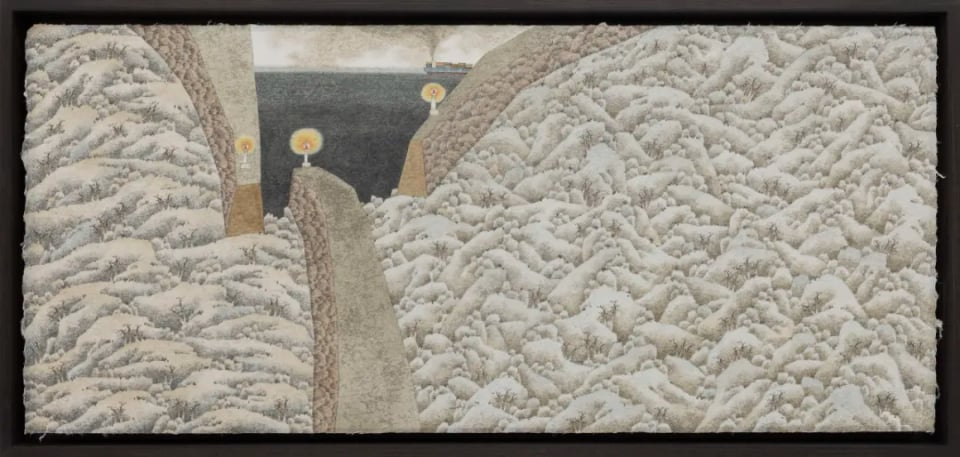
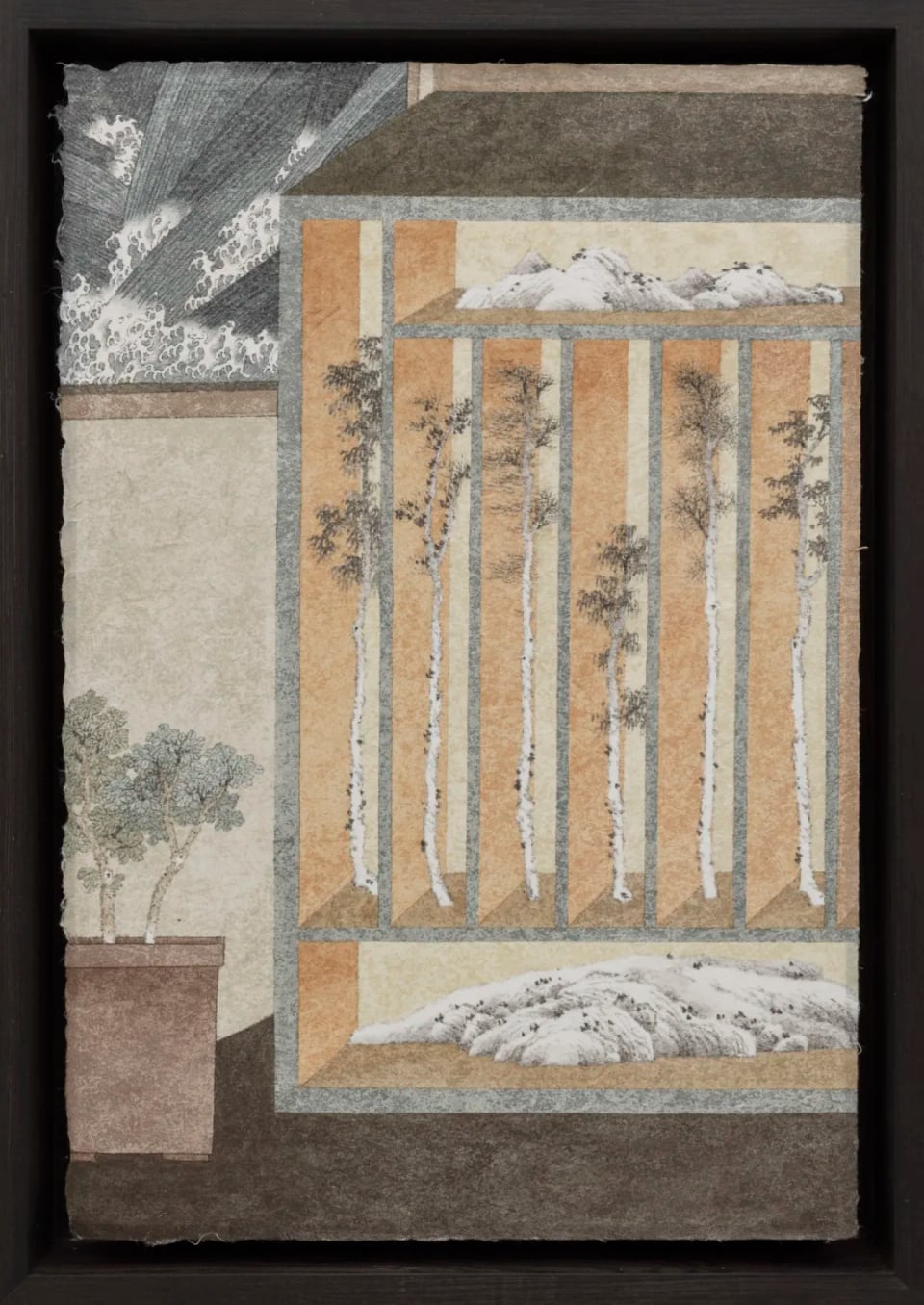
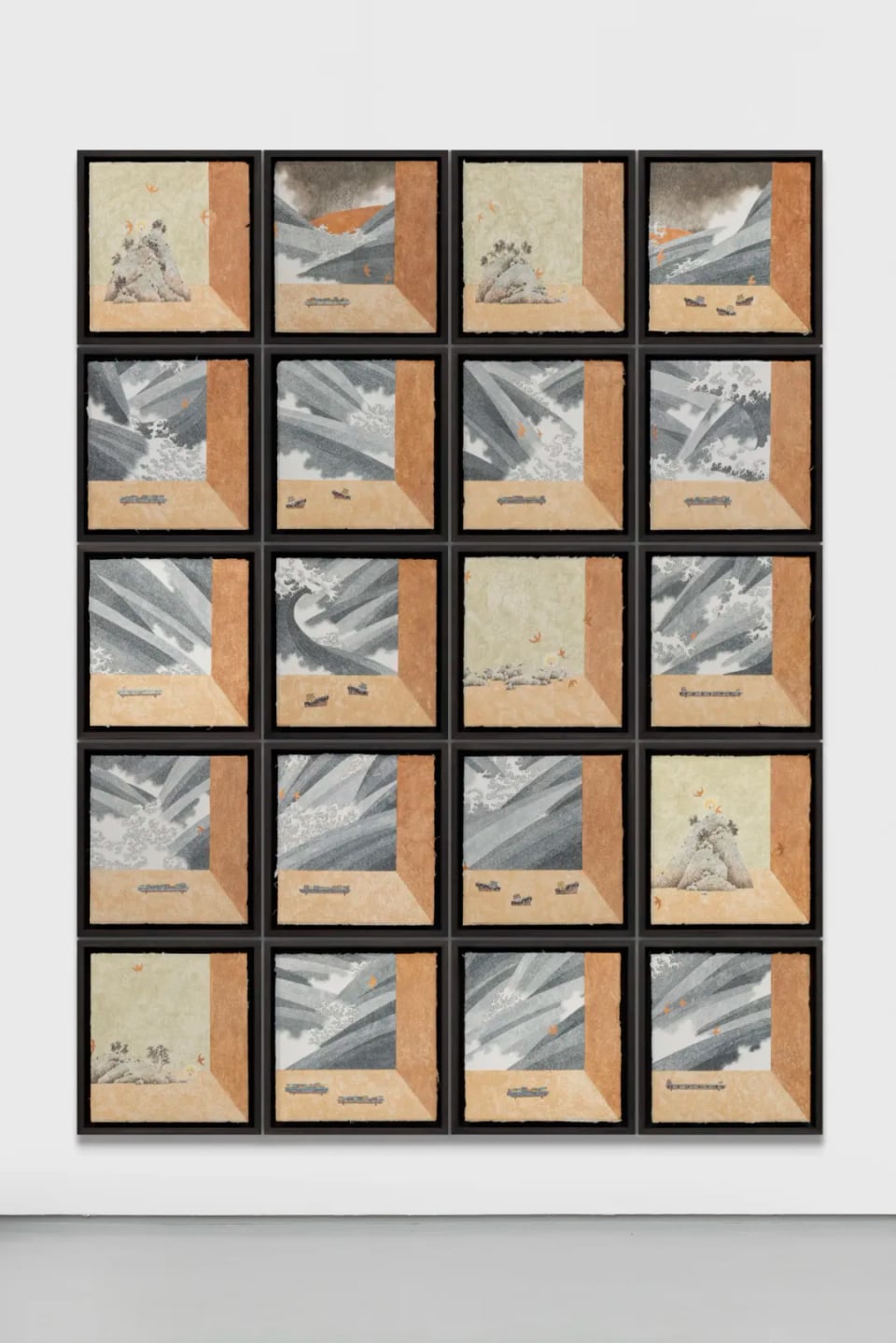
In formal terms, the artist takes water as her primary medium, employing ink and copper leaf to construct a visual system that is fluid and unstable. Boats appear as traces of passive drift, while trees emerge as structural projections of individual existence. The silver and copper leaf oxidize over time, the brightness of the leaf gradually darkened, so that the images themselves undergo continuous change—matter no longer stable but slowly transforming in time. Compositions are deliberately tilted and compressed, confining landscapes within the boundaries of the paper, as if everything were imprisoned by an invisible structure.
The exhibition's narrative unfolds from "waves," pointing to the turbulence and pressure of the external world. Great waves surge, boats lose their order, and individuals drift passively within, unable to steer their course. Following this, the "harbors of refuge" and "pines" that appear throughout the exhibition interweave: on one hand, the harbor as a structure of refuge gradually fails, the order has hollowed out, safety becoming a residual apparatus that merely gestures at protection; on the other hand, individuals turn inward, growing like pines within constraints, sustaining a mode of existence that remains unstable yet ongoing.
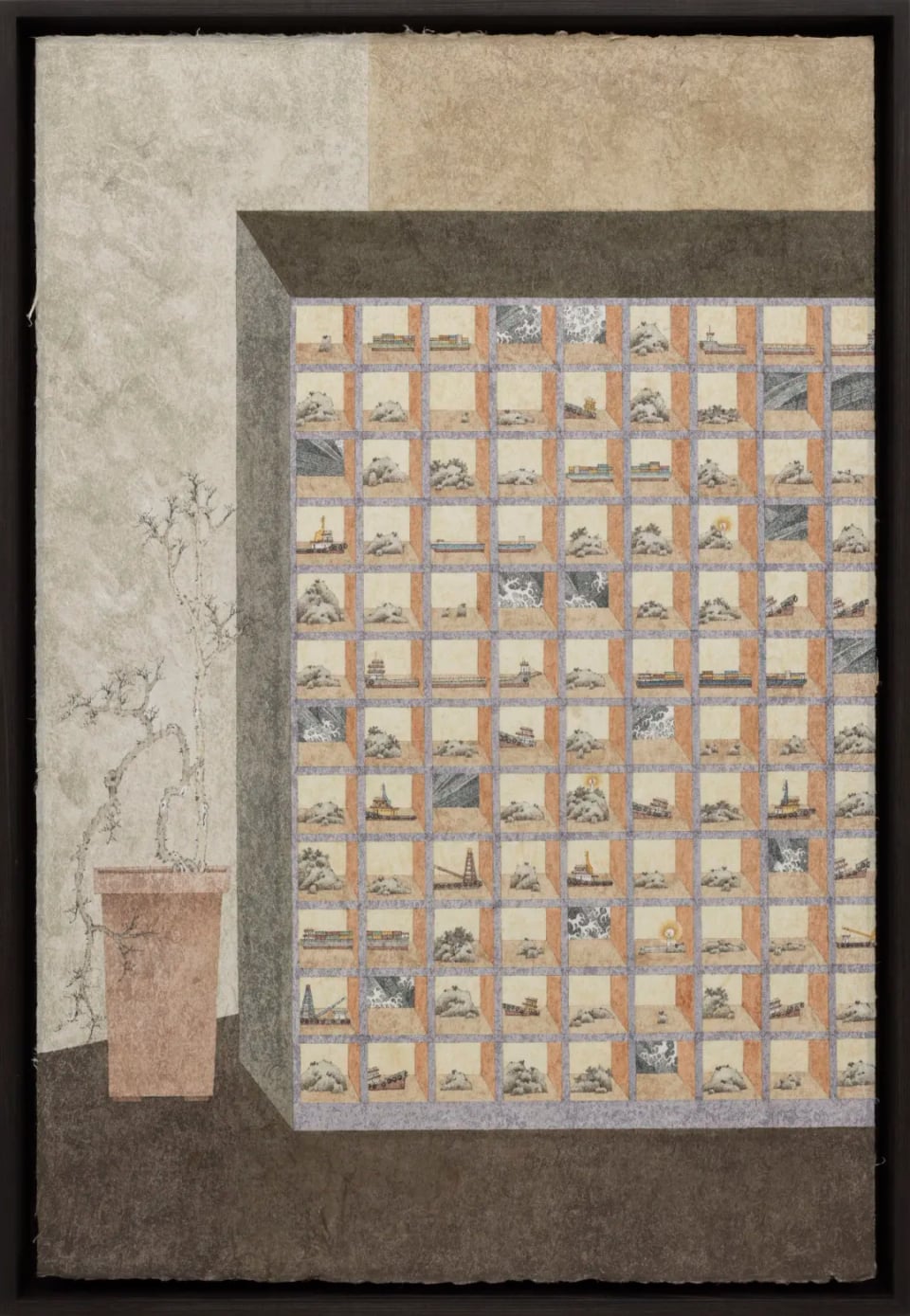
In this process, the "cabinet" emerges as a recurring structure. Whether containing trees or partially sealing away landscapes, it is both a response to external turbulence and a provisional fixing of the individual's state—an attempt to establish boundaries amidst disorder. This culminates in the "The Cabinet of the Floating World”. The external world is dismantled, categorized, and stored within compartments, forming an artificially constructed order. Turbulence is frozen into images; crisis is filed away as something to be viewed.
Stepping into the gallery, the viewer experiences not a violent catastrophe but a continuous, silent sinking. Destruction is never clamorous—it happens without sound, without trace, without form. We invite the viewer to gaze upon these dissolving waters: in the self-transformation of matter, to sense the fragile, unstable connection between oneself and the world, and within helplessness, to recognize a subtle, poetic mode of being that nonetheless persists.
Images of the exhibition