Exhibition detail
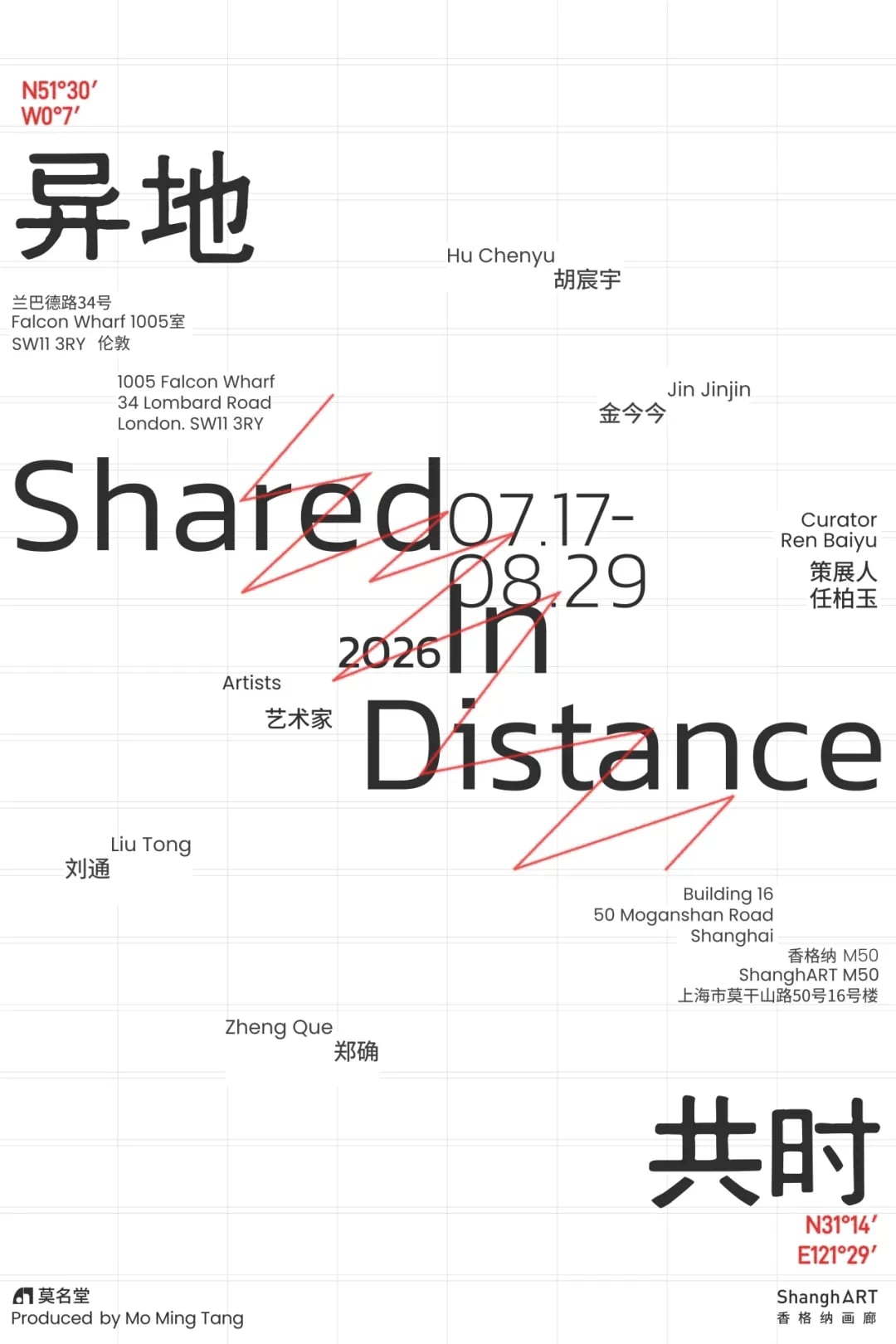
The Passage: Shared In Distance
Dates
Jul 17 - Aug 29
Location
Building 16, No. 50 Moganshan Road, Putuo District, Shanghai
Putuo
Shanghai
Press Release
Presented in the corridor within ShanghART’s M50 space, the project runs in parallel with the exhibition in the gallery’s main space. By drawing on this unconventional site, it explores a wider range of exhibition formats. As a transitional zone connecting different spaces, the passageway is neither the beginning nor the end of an exhibition, but a place where pausing and passing through coexist. As the word “Passage” suggests, it refers not only to movement through space, but also to transition, circulation, and arrival. The project therefore does not regard an exhibition as a complete and self-contained outcome. Instead, it approaches each presentation as a path towards new ways of seeing, thinking, and engaging in dialogue.
Shared in Distance
Participating artists: Hu Chenyu, Jin Jinjin, Liu Tong, Zheng Que
What we see is one half of something.
At this very moment, the exhibition In Distance in London is presenting four works concerned with separation, displacement, obstruction, and misalignment. At the same time, the exhibition Shared in Shanghai is presenting four works concerned with synchronisation, connection, communication, and sharing. Remotely, faintly, yet undeniably, together they are forming a spatiotemporal structure of being shared in distance.
And you are the passage.
Here, your time will be adjusted to the time of another place: seven hours earlier, or seven hours later. You are neither entirely in Shanghai nor entirely in London. You will find yourself at a kind of seam—no, you are the seam itself. You will lay claim to one half of something, while your gaze, your footsteps, and your fingertips awaken the other.
When footsteps are heard here, mimosa plants in a distant place close their leaves. As a person and a hot-air balloon drift apart, the Northern and Southern Hemispheres rotate in synchrony. It took eight minutes to find Shengbang International Building, yet finding spring requires only a kiss carrying the scent of pine resin. Unable to understand Japanese, I can only answer you with a whistle; but since it is snowing, I will bring you a snowfall.
It is precisely the half that you see that allows the possibility of the other half to emerge. Just as a lion’s mane mushroom growing on one side of a tree suggests that another may be growing not far away on the opposite side. What matters is this certainty: knowing before seeing. To see one half is to see the whole. Could our experiences of distance and simultaneity exist in a similar relationship? In separation, what is being separated may in fact be a connection that cannot be severed. In the process of becoming one, what we recover may be something we only believed we had lost.
Moving back and forth between binary poles and the spaces between them, we sometimes suffer and sometimes feel immense happiness. But could these states be ways of pointing towards one another? “There is a resemblance between the low and the high,” Simone Weil once wrote. Perhaps to experience one is already to experience the other—and therefore to experience the whole. This is a bold hypothesis: within a certain wholeness that is difficult to perceive, we have never truly been damaged. What appears damaged has merely been transferred elsewhere. While misunderstanding, we may also be understanding. When we think we have taken the wrong path, we may already be arriving. Usually, we understand this only much later, when time and space have completed what was missing.
Could this understanding be brought forward? Could we live directly within such certainty, as the lion’s mane mushroom does? And if this seems impossible in reality, then let us construct it: send signals from London and Shanghai, allowing the experiences of distance and simultaneity to connect in the air—remotely, faintly, yet undeniably. At the exit, you can call the exhibition on the other side from your phone, scroll through its social-media feed, and see what is being shown there. From afar, it will complete the other half, creating a sphere that extends above all of us.
A sphere is an arrival produced by one point’s complete trust in another. It, too, is a kind of passage—or rather, a collection of countless passages: between searching and creating, between a whistle and snow, between remaining in place and being thousands of miles away, between the Southern and Northern Hemispheres. It is not a movement from one point to another. Rather, through the withdrawal of the self, it is the repeated act of trusting what lies deep beneath the surface: what is delayed, what cannot yet be understood—until we touch our own opposite and become another point.
—Curator Ren Baiyu