Majestic Mountains and Expansive Rivers by Lê Giang
Press Release
In her broader practice, Lê Giang has captured the architecture of communal houses, probed their colonial histories, and explored cultural perceptions of the natural world. With a strong interest in Việt Nam's artisanal practices and customary beliefs, she experiments with a variety of mediums, including the vernacular techniques of plaster-casting, inlay, paper-embossing and, more recently, 'painting' with gemstones.
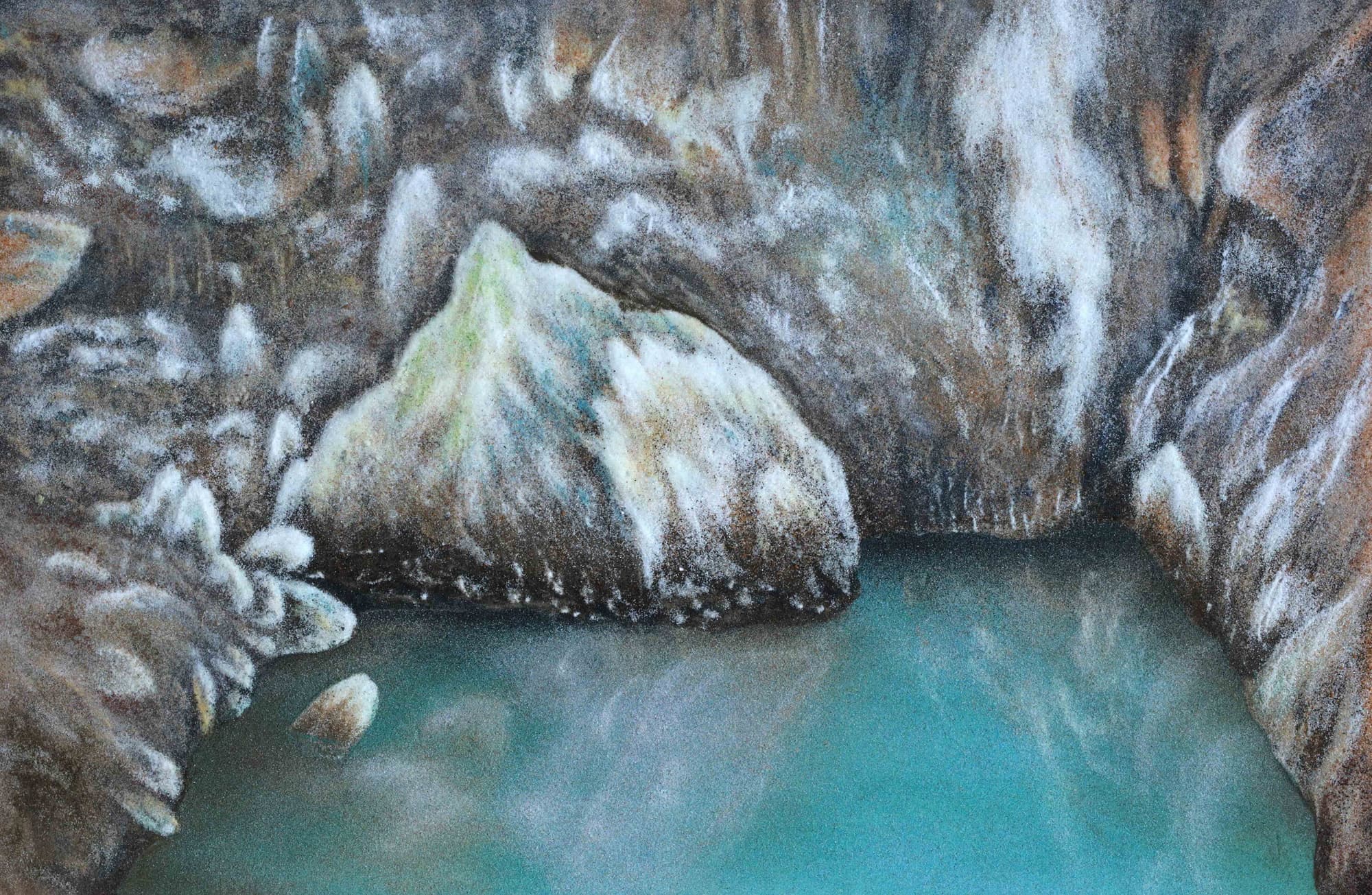
In 2020, Lê Giang undertook research in the provinces of Yên Bái and Nghệ An in north Việt Nam. Since the late 1980s, these provinces have developed as major gemstone trading centres, while the practice of gemstone painting, in which the natural world is exalted and idealised, has also emerged in the north. Lê Giang spent time working with the artisans and observed how they make their paintings from the leftover 'impure' cuttings of precious gems, which are carefully sorted according to size and colour before being crushed into a fine powder.
The artisans place a drawing or design below a sheet of perspex, and, using it as a guide, expertly sprinkle the powders to create a composition; they then affix the powders with copious amounts of liquid glue. As a last step, they scrub and wash their creations to achieve a flat surface that glistens in the light. The gem painters favour a genre of landscape painting known as Sơn Thuỷ Hữu Tinh (Majestic Mountains and Expansive Rivers), alongside portraiture and still lifes.
Lê Giang acknowledges how such paintings serve a dual purpose: they express a cultural perception of the natural world as a symbol of purity, while also conferring good fortune, prosperity, longevity and other desirable attributes on their owners. A vibrant online market has developed for these gemstone paintings, which are shipped across the country and internationally.
Drawing on the skills she observed in the north, Lê Giang created a group of 14 gemstone paintings, titling them Sơn Thuỷ Hữu Tình (Majestic Mountains and Expansive Rivers) in recognition of the genre. Some of the works appear abstract, replicating the surface of the cut gemstones to imply the process of their extraction in the gouging of the earth. Departing from the distant, awe-inspiring view of a sublime nature, these works use an intimate lens to reveal flaws and fissures.
Contrasting with these is a series of representational landscapes, depicting areas that have been ravaged by open extraction mining and pollution. Initially, the images appear enchanting, with their shimmering surfaces and seductive colours, but a feeling of unease emerges on closer inspection - trees are sickly, barren of leaves; weeds flourish; erosion is widespread. The landscape is suffering. Lê Giang's paintings deliberately embody a contradiction - the practice of gem mining in the provinces is not legal, and has led to environmental issues, including the pollution of lakes, which are sources of fresh drinking water, and the deforestation of areas considered sacred in local spiritual practices.
The mine sites are also notorious for poorly monitored labour conditions, often resulting in serious injury or death for the grossly underpaid workers. Drawing attention to the irony inherent in the pristine images of towering mountains and flowing rivers, Lê Giang uncovers the darker environmental, social and economic realities that they obscure.
Aware of the local beliefs and folklore that attribute spiritual significance and souls to certain stones, she uses her gemstone paintings to reflect on the way sacred objects and practices have been transformed into saleable goods, conferring virtue on the buyer, who is detached from their history and significance - and their destructive means of creation.
Images of the exhibition
